
Have you ever felt your head buzzing with ideas, theories, and advice, yet found it enormously difficult to put anything into practice? As if there were an invisible barrier between what you know and what you do?
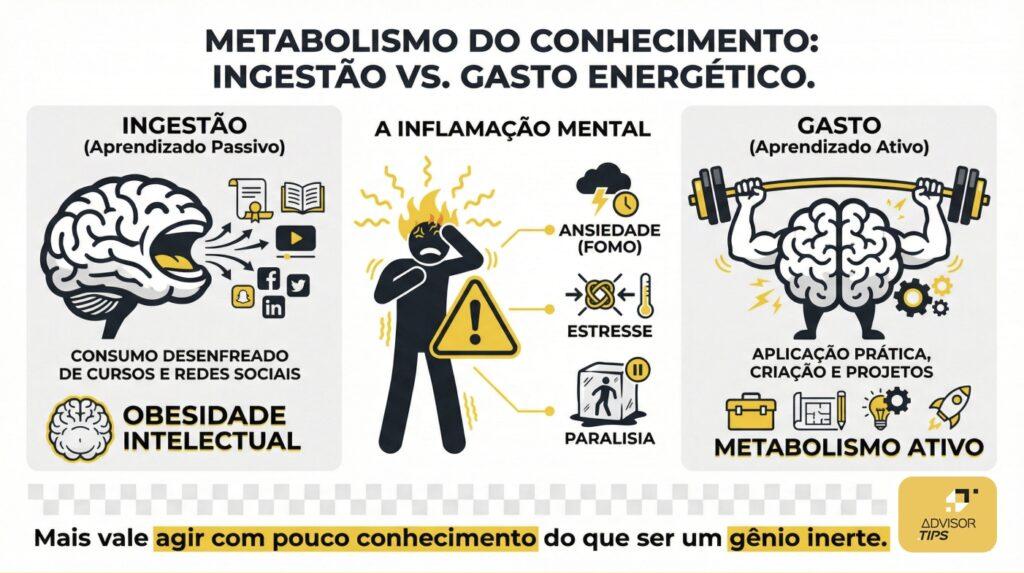
Never in history have we had as much access to information as we do today. Whether through the ever-growing reach of social media or through training courses and programs offered online, which can supply us with knowledge without us even having to leave where we are. But this unrestrained pursuit of knowledge, taking courses one after another, joining forums and networks, receiving mentorships, and being bombarded with information from everywhere and everyone, without having time to absorb and put that knowledge to use, is what we call Intellectual Obesity.
This is the increasingly common reality of an overloaded, inefficient brain, swollen with data that is never processed, applied, or shared. It is like eating without spending, without metabolizing. In this scenario, knowledge turns into a kind of mental fat: it does not nourish us; it inflames us, it makes us sick.
One factor may have contributed to this boundless pursuit of knowledge. During the pandemic, access exploded. Social media, newsletters, podcasts, webinars, stage mentors, on-demand gurus. It is an endless banquet, a free buffet of content that stuffed us until we were exhausted from so many live streams and courses available. And the result? A great deal of knowledge, with no opportunity to apply it.
The insatiable thirst and the silent exhaustion
I decided to study the subject, and in my research and personal experience I found that we are not alone in this journey. In 2023, ScienceDirect reported that the global digital population produced approximately 328.77 million terabytes per day. Imagine the volume of information competing for our attention. It is a costly banquet that, ironically, leaves us more exhausted and poorer in what we have that is most valuable: time and energy.
The e-learning market, for example, exploded to US$ 486 billion in 2025, according to a study by Research.com. Millions of people seeking knowledge, but how many actually apply it? How many transform that passive learning into action? Most, I venture to say, are simply accumulating. And what happens with accumulation without spending? It generates a subtle anxiety, a feeling that we are always missing out on something, the well-known FOMO (Fear Of Missing Out). You feel constantly behind, insufficient, as if there is always one more course, one more book, one more podcast you need to consume to avoid falling behind. But deep down, this incessant pursuit only drowns us further in content, without giving us the clarity or the energy to act.
The conscious diet
The problem is not knowledge itself. The problem is compulsion. It is the lack of curation. It is the illusion that "knowing" is the same as "doing". I see people with dozens of certificates, yet paralyzed when the time comes to take the first step. With a great deal of theoretical knowledge, but without the practical wisdom that only experience can bring. This superficial knowledge, unexercised, unadapted to reality, can become dead weight in your mind.
My proposal for you is an invitation to reflection: if you do not have a clear plan to apply what you learn, perhaps it is time to start a new knowledge regimen. Do not stuff yourself. Having a banquet of information is pointless if your body, or your mind, cannot digest it. The priority is no longer "learning more", but "applying what you already know".
It is time for a conscious diet. To curate the content you consume. To have a plan, a clear objective for each new piece of information. Ask yourself: Where will you use this? What problem will you solve? What project will you get off the ground? If the answer is not clear, that may be a signal to close the browser tab and dedicate yourself to turning what you already know into something concrete.
Some tips on how to overcome intellectual obesity
Active curation: Be selective. Choose information sources that genuinely add value to your goals. Turn off unnecessary notifications and reduce time on social media that generates only noise.
Deliberate application: Transform passive learning into active learning. Create a project, write a text, join a debate, teach someone. The best way to consolidate knowledge is to use it.
Strategic breaks: Give your brain rest. Alternate study with physical activity, hobbies, or simply moments of creative idleness. The brain needs time to process and consolidate information.
Conscious disconnection: Reduce screen time. Reconnect with the real world, with people, with nature. Life happens outside the screens.
Prioritize action: Remember that real value lies in execution. One small practical step is worth more than a thousand unapplied theories. Start small, but start.
In a world where information is infinite and time is finite, doing something with the knowledge you have acquired is the true differentiator. Intellectual obesity is not a sign of intelligence; it is a symptom of something that will leave you increasingly less active. It is the banquet that drains us and prevents us from creating something of value. The time has come to put all your knowledge into practice. To spend that energy. To transform knowledge into sweat, into results, into impact.
It is the journey of conscious, planned action that will lead us to a more productive and meaningful future, grounded in the knowledge we already have.
Article also published on GazzConecta.