
Every business owner knows exactly what their company's purpose is: sell products, deliver services, solve problems, generate profit. That is what drives day-to-day operations, consumes energy, and sets priorities. But here is the question few people ask: what is your company's destination?
The difference is simple, but crucial.
Purpose is what you do today. Destination is where your company is going tomorrow.
The Problem: We Live Obsessed with Purpose
That is understandable. Purpose is urgent, tangible, and measurable. Monthly sales, cash flow, customer satisfaction, team productivity. These are metrics that knock on the door every day demanding attention.
Destination, on the other hand, seems abstract. "I will think about that when the company is bigger", "when I retire", "when an opportunity comes up". The problem is that destination is not optional, every company will have one, planned or not.
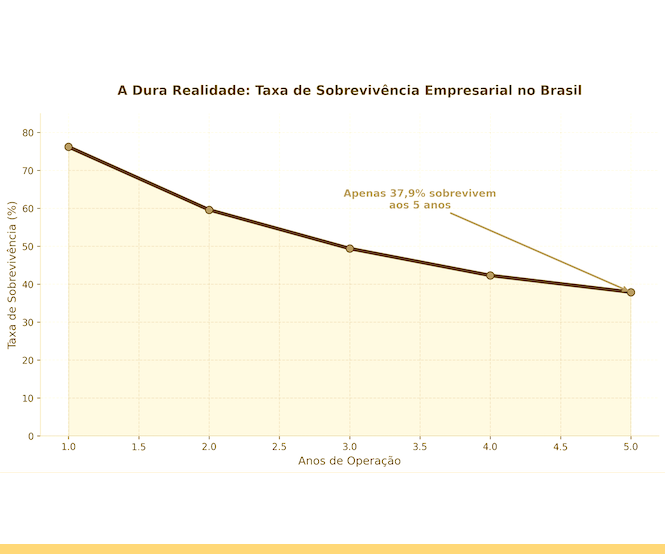
The data is unrelenting. Of the companies founded in 2017, only 37.9% were still active in 2022. The mortality curve is consistent and predictable: every year, more companies disappear [2].
The Three Inevitable Destinations (There are no others)
Every company, without exception, will reach one of these three destinations:
1. Merger or Acquisition (M&A): The Strategic Harvest
For well-structured companies, M&A is the opportunity to turn years of work into real value. The Brazilian market is active, with 2025 recording 14.6% growth in transactions and a projection of 1,400 deals in the year [3].
But M&A is not a lottery. Companies that achieve good valuations have one thing in common: organized governance, documented processes, and a long-term vision. Those who live only in purpose, without thinking about destination, arrive at the negotiating table disorganized and lose value.
2. Succession: The Art of Perpetuating the Legacy
Succession is the dream of many founders, especially in family businesses, which account for 90% of Brazilian companies and 65% of national GDP [4]. But the reality is harsh: only 30% of family businesses survive the transition to the second generation, and only 12% reach the third [5].
The main reason? Lack of planning. Only 25% of family businesses in Brazil have a formal succession plan [5]. The rest live under the illusion that "when the time comes, we will figure it out".
3. Closure: When Destination Is Decided by Circumstances
Here is an important clarification: not every closure is bankruptcy. Companies can be shut down for various legitimate reasons, such as a change in strategy, a partner's exit, a pivot to new businesses, or simply because the founder decided to pursue a different path.
The problem is not closure itself, but when it happens due to lack of planning. When the company closes because "it did not work out", because resources ran dry, because partners clashed, or because no one thought about what to do when the founder could no longer run the business.
Why Ignoring Destination Is Costly
Failing to plan for destination generates consequences that go far beyond closure:
Business Devaluation: A company without clear governance and organized processes is worth less to buyers and investors.
Unnecessary Conflicts: Without a clear plan, disputes between partners and heirs bring operations to a halt.
Loss of Knowledge: An abrupt founder departure takes intellectual capital and strategic relationships along with it.
Missed Opportunities: Companies that do not prepare miss M&A or succession windows during favorable moments.
"The departure of an experienced professional can lead to the loss of valuable knowledge and expertise for the company. The lack of a succession plan can devalue the company, making it less attractive to potential buyers or investors." - Edson Santana, Edson Santana Advogados [4].
The Solution: Plan the Destination from the Start
Destination is not something to think about at the end, it is strategy from day one.
Business owners who think about destination early make different decisions. They invest in governance, document processes, develop teams, and structure the company to be attractive, whether for buyers, successors, or an organized exit.
Five Practical Actions:
• Define your preferred destination: M&A, succession, or a planned exit? It does not need to be final, but it needs to be deliberate.
• Invest in governance: Clear processes, organized documentation, and separation between personal and corporate assets.
• Develop people: Prepare successors, whether within the family or the team. This increases the company's value in any scenario.
• Know your value: Conduct periodic valuation assessments to understand what your company is worth today and what it could be worth tomorrow.
• Seek specialized guidance: Consultants in M&A, succession, and governance are not a luxury, they are a strategic investment.
The Choice Is Yours
The difference between business owners who build legacies and those who become statistics lies in the willingness to face a simple truth: every company will have a destination. The only question is whether you will choose it or whether circumstances will choose it for you.
Purpose keeps your company alive today. Destination ensures it has value tomorrow.
The question is not whether your company will have a destination. The question is: who will decide what it will be? You, or chance?
C-Level | Board Member | Advisor | Mentor
Founding Partner at AdvisorTips
This publication is part of the Advisor.Tips website and is protected by copyright.
References
[1] Exame. (2024, December 5). 60% das empresas não sobrevivem após cinco anos no Brasil, aponta IBGE. https://exame.com/negocios/60-das-empresas-nao-sobrevivem-apos-cinco-anos-no-brasil-aponta-ibge/
[2] IBGE. (2024). Demografia das Empresas e Estatísticas de Empreendedorismo 2022.
[3] Trade. (2025, August 11). Crescimento de M&A no Brasil em 2025. https://tradecon.com.br/crescimento-de-mea-no-brasil-em-2025/
[4] TrendsCE. (2024, April 17). Empresas familiares no Brasil respondem por 65% do PIB. https://www.trendsce.com.br/2024/04/17/empresas-familiares-no-brasil-respondem-por-65-do-pib/
[5] Renda Maior. (2025, April 25). Estratégias de Saída (Exit Planning) para Empreendedores: Guia Completo. https://rendamaior.com.br/estrategias-de-saida-exit-planning-para-empreendedores-guia-completo/