In any organization, whether public, private, or nonprofit, there is a truth that, when ignored, tends to be costly: Risk and Control are siamese twins. Where one exists, the other must necessarily exist as well. Separating them is not only a conceptual error; it is an operational, strategic, and often fatal one.
The classic mistake: assuming that risk is merely an abstraction.
For a long time, risks were treated as theoretical elements, something confined to the papers of auditors, consultants, or formal governance committee meetings. However, risk is everything that can affect the achievement of an organization's objectives. It is present in every contract, every operation, every decision, and above all, every omission.
The problem starts when people believe that risk can simply be mapped, recorded in a neat matrix, and then filed away. If that is not directly connected to effective, living controls in day-to-day operations, it serves no purpose.
Control without risk is blind. Risk without control is reckless.
Imagine a company that defines a series of operational, financial, and technological controls but does not start from an analysis of its actual risks. That company will likely spend energy, money, and time on unnecessary controls, failing to protect what truly matters. Control without risk is bureaucracy.
On the other hand, mapping risks without designing the corresponding controls is as effective as locking the door and leaving the key in the lock on the outside. Risk without control is negligence.
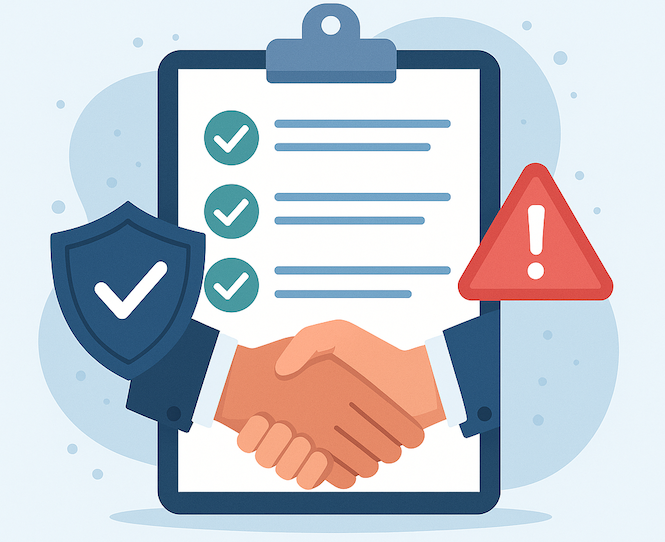
The correct equation: Risk + Control = Responsible Management
In practice, mature management understands that:
• Every identified risk must generate a corresponding control. If there is a fraud risk in the payment process, the control may be a daily reconciliation, a segregation of duties, or third-party validation.
• Every implemented control must mitigate a specific risk. If a checklist exists in the logistics process, it cannot exist out of tradition or habit. It must be directly tied to mitigating a real operational risk, such as loss of goods or delivery failure.
When risk and control move together, true preventive governance emerges, protecting the business, its reputation, its resources, and even the continuity of operations.
Signs that they are moving separately (and that is a problem)
• There are many controls, but nobody knows exactly which risk they mitigate.
• Sophisticated risk maps exist, but there is no updating of processes or operational controls.
• Internal control is seen as "the department that creates bureaucracy," rather than as an ally of management.
• Audits point to the same failures year after year.
If they are not hand in hand, something is wrong.
Risk without control generates insecurity. Control without risk generates waste. And both, when disconnected, leave the organization vulnerable, whether to financial losses, fraud, operational errors, or reputational damage.
Therefore, managers, controllers, auditors, and leaders need to abandon the view that risk is a "compliance problem" and that control is a responsibility of "the operational department." It is all part of the same organism. A mature organization connects its risk map directly to its control matrix. If they are not hand in hand, something is wrong, and dangerous.
The path is integration.
The invitation, therefore, is clear: break down the silos. Integrate risk, control, and management. Transform the organizational culture so that everyone understands that control is not an obstacle but a protection, and that risk is not a problem but strategic information.
Companies, governments, and institutions that learn this lesson will move ahead. And those who insist on separating risk from control will inevitably learn it the most costly way: through the occurrence of the uncontrolled risk itself.
Article also published on LinkedIn.