

The Slow Death of ICMS and ISS (2029-2032)
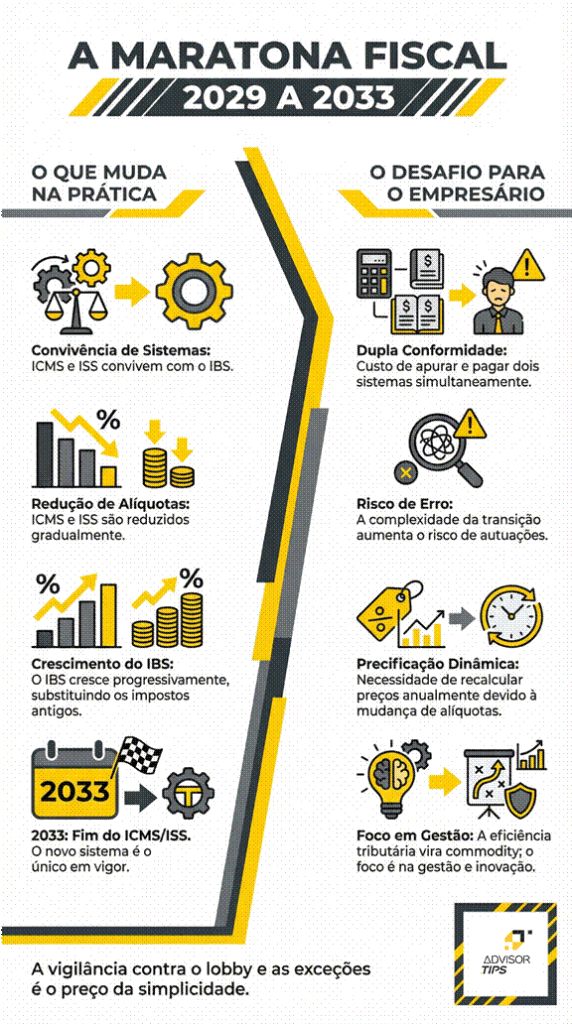
Imagine driving a car with two steering wheels for four years. That is exactly what is going to happen. From 2029 to 2032, the IBS (the state/municipal tax) will grow progressively, while ICMS and ISS (the monsters we learned to resent) will be reduced by the same proportion.
In practice, this means:
Dual Calculation: Your accounting team will have to calculate and pay under both systems. Compliance costs will go through the roof. The risk of error is doubled.
Systems Conflict: Your ERP and billing systems will need to be robust enough to handle rates that change every year, in a complex interplay between what is being phased out and what is being phased in.
Dynamic Pricing: How do you price your product or service when the tax burden changes annually? Strategic planning becomes an exercise in forecasting the unknown.
This is the "fiscal purgatory" phase. The old system's burden still exists, and the new system's benefits have not yet arrived. This is the moment when the organization and technology you put in place back in 2026 will separate those who prepared from those who were caught off guard.
2033: The End of an Era (And the Beginning of Another)
Finally, on January 1, 2033, ICMS and ISS are officially abolished. Brazil joins the club of countries with a modern VAT. The old system, with its alphabet soup of acronyms and its thousand exceptions, becomes a museum piece.
On paper, it looks great. A simplified, transparent system that does not burden investments and exports. But then comes the R$ 1 trillion question.
The Revenue Risk vs. The Economic Reform
The great promise of the Tax Reform was never just simplification. It was to unlock Brazil's growth. The expectation is that a more efficient system will generate additional GDP growth, attract investment, and bring the informal economy into the formal sector.
But what is the risk that all of this turns out to be a mirage? The risk is that the reform gets used as a mere instrument for collecting taxes differently. In other words, the government discovers that the new system is so efficient at collecting tax that the temptation to raise the rate to cover fiscal deficits becomes irresistible.
If the final tax burden, combining CBS, IBS, and the Imposto Seletivo, ends up higher than the current one, the reform will have failed its economic purpose. We will have a simpler system for paying more tax. It is like trading a horse cart for a Formula 1 car, but only to drive on the same potholed road.
The Problem of Lobbying and Sectoral Interests
And here enters the greatest enemy of any good idea in Brazil: lobbying. The beauty of a VAT is its simplicity and neutrality. But every time a sector secures a benefit, a reduced rate, or a special regime, a piece of that simplicity dies.
We have already seen this happen. Sectors such as healthcare, education, agribusiness, and transportation have already secured their advantages. The question is: where does it stop? What is the likelihood that future governments, pressured by their campaign donors and interest groups, will not distort the reform to the point where it becomes a new patchwork of rules?
Every exception is a nail in the coffin of efficiency. Every sectoral privilege is an invitation for your competitor to ask for one too. If there is no political safeguard and no shared understanding that the interest of the whole outweighs the interest of the part, we risk arriving at 2033 with a system just as complex as the one we just buried.
The Day After: What Is Left for the Business Owner?
After 2033, the game changes. Competition will no longer be about who has the best tax juggler on staff. It will be about who has the best product, the best service, the best logistics. Tax efficiency will become a commodity.
The business owner who survives this journey will need to be a master of management, innovation, and strategy. The accountant will stop being a "form filler" and become a data analyst and a vital strategic partner.
The challenge is significant, but so is the opportunity. The Tax Reform, if well executed and protected from the usual opportunists, may finally allow the Brazilian business owner to focus on what they do best: generating wealth.
For that to happen, however, societal vigilance and the courage to say no to narrow interests will be just as important as the law itself. The reform is not a destination. It is a choice we will have to make every day, from now through 2033 and beyond. Participating in the debates and staying in contact with those who may still shape some of the outcomes is a very important practice, and one I recommend to everyone.
Article also published on GazzConecta.