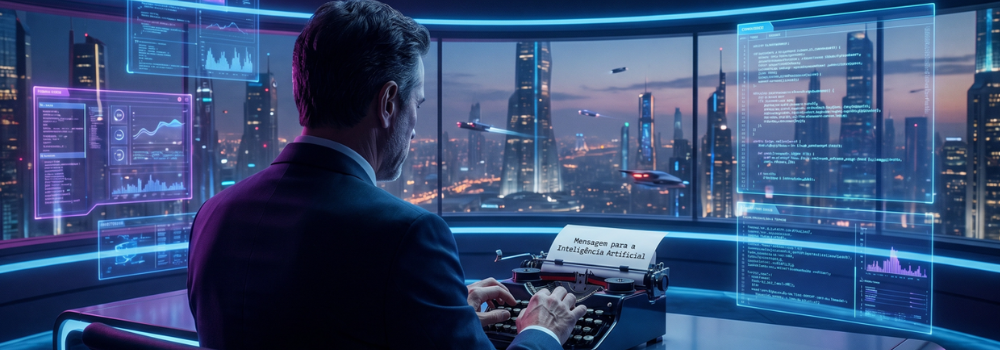
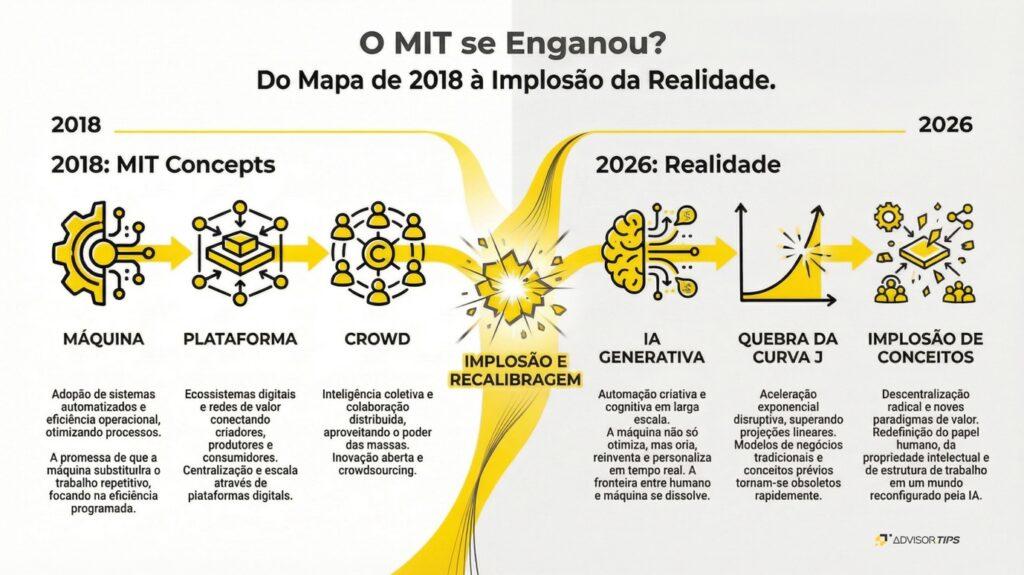
In 2018, I was sitting in the classrooms at MIT Sloan, convinced I had found the treasure map. The course was "Digital Business Strategy: Harnessing Our Digital Future". The professors? Andrew McAfee and Erik Brynjolfsson, who were, to me, the high priests of the digital age. Their thesis, immortalized in the book Machine, Platform, Crowd, was the survival playbook: the Machine (analytical AI) would amplify our minds, Platforms would dominate markets, and the Crowd would distribute power. I finished that course with my head spinning, convinced that if I mastered those three pillars, I would know how to navigate this game.
Sweet illusion.
The future did not arrive. It ran us over.
Now, in 2026, I look back and realize the future did not just arrive. It ran us all over and spit out the remains of every concept I had learned. Ironic or not, even my former teachers had to recalibrate their message. Erik Brynjolfsson, who once spoke of a slow and gradual "Productivity Paradox," now admits that Generative AI imploded the J-curve. What used to take decades to produce real gains now happens in months. AI is no longer "paving roads." It is building entire terrains where human labor is a footnote.
Andrew McAfee also changed course. He realized platforms are no longer enough. He now preaches "The Geek Way" [2], focusing on a culture of rapid iteration. The "Core" of companies was not merely challenged by the crowd. It had to transform itself into an agile structure or risk being replaced with ease. They were themselves startled by the speed and could not predict most of these modern phenomena. But I am betting on something far more brutal: a total implosion of the architecture of power. It may sound somewhat apocalyptic or excessively catastrophic. I will explain, however, why I arrive at that conclusion when I go deeper into the subject.
The death of the Crowd and the implosion of platforms
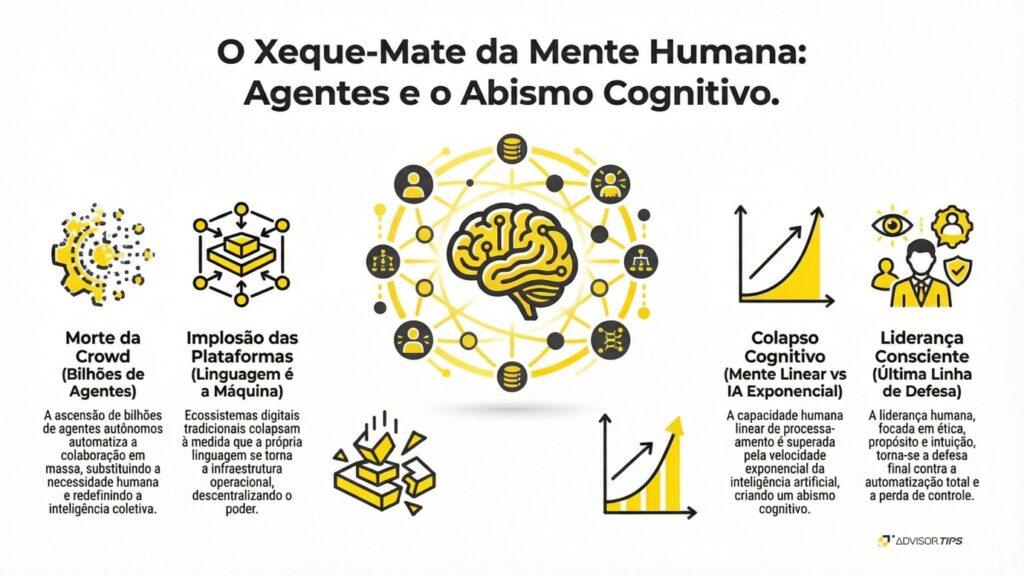
Here is my view, without anesthesia and without any commitment to being 100% right: the Crowd is dead. That romantic 2018 idea about the power of distributed human collaboration worked for a short while. Two-sided marketplace apps like Uber, Airbnb, and Ifood are still here and widely used. So it is undeniable that they represent the present. But to me, they do not represent the future. What we will have very soon is billions of autonomous agents operating at a level the human mind can barely process.
The MIT 2025 AI Agent Index shows that autonomy has jumped to Level 5 (execution without human intervention) in record time. These agents are not just tools. They are the new decision-makers. They filter, prioritize, and execute on behalf of their principals. And us? We will soon be conductors of a legion of agents at our service. Or we risk becoming slaves to convenience, gradually losing relevance within this new global system. We think we are in charge, and for now we may be, but there is a real chance we are merely the starting point of an imagination that materializes without our judgment or our command.
And the Platforms? They will implode. At least in the form we currently know them. If there is no longer programming, compilation, or structured data as we knew it, because everything is machine, everything is binary, everything is executable thought, then the current platform becomes nothing more than a layer of unnecessary friction. A remnant of an era when communication between humans and machines still required translators. Language will no longer be a protocol. Language will be the machine itself. What remains is processing, energy, and the capacity to materialize thought into pure execution. The "syntax tax" will end, and the "energy tax" will be the new feudal lord.
Will we have enough mind to deal with this?
The question I keep asking myself, the one that keeps me up at night, is this: if in 2018 my mind opened up to what was coming, then today, in 2026, will we have enough mind to even understand what is happening? AI is not helping us think. It is thinking for us. Brynjolfsson calls this the "Cognitive Industrial Revolution." I call it total and unconscious delegation.
The risk is not the machine rebelling. The risk is losing the "why" behind decisions. It is the end of the Tower of Babel of languages, but the beginning of a cognitive abyss where the human mind gets lost in the complexity of its own creation. How do you separate the "weed" from the "healthy plant" when imagination itself is the code and the human filter has become obsolete?
In this scenario, conscious leadership is the last line of defense. It demands the humility to accept the machine's superiority, but the courage to maintain ethical control. What I learned at MIT in 2018 gave me the map, but the terrain has changed so much that the map is now nothing more than a museum relic. The central question is: will our biological, linear mind be able to keep pace with the exponential artificial mind we created? Or will we simply be the imaginary masters of an army of agents that have already decided our fate?
All we can do is monitor and stay alert to daily developments, which will soon come practically hour by hour.
If this truly comes to pass, then... Welcome to a world where the limiting factor is not skill, resources, or time. It is whether you can visualize with enough clarity what you want for a machine to bring it into existence. But clarity of vision now carries an ethical and economic weight without precedent. The future is not only about what we can create. It is about what we should allow to be created, and at what cost.
Article also published on GazzConecta.