
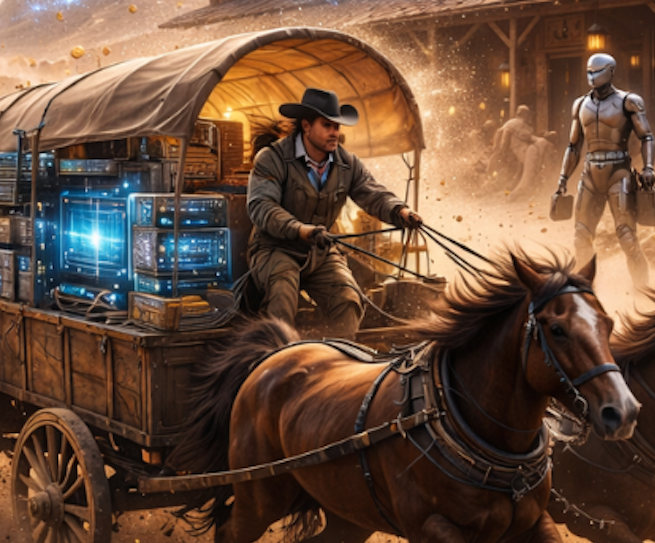
We are living through the greatest "wild west" in our history. And no, I am not talking about John Wayne movies or stagecoaches crossing the desert. I am talking about artificial intelligence.
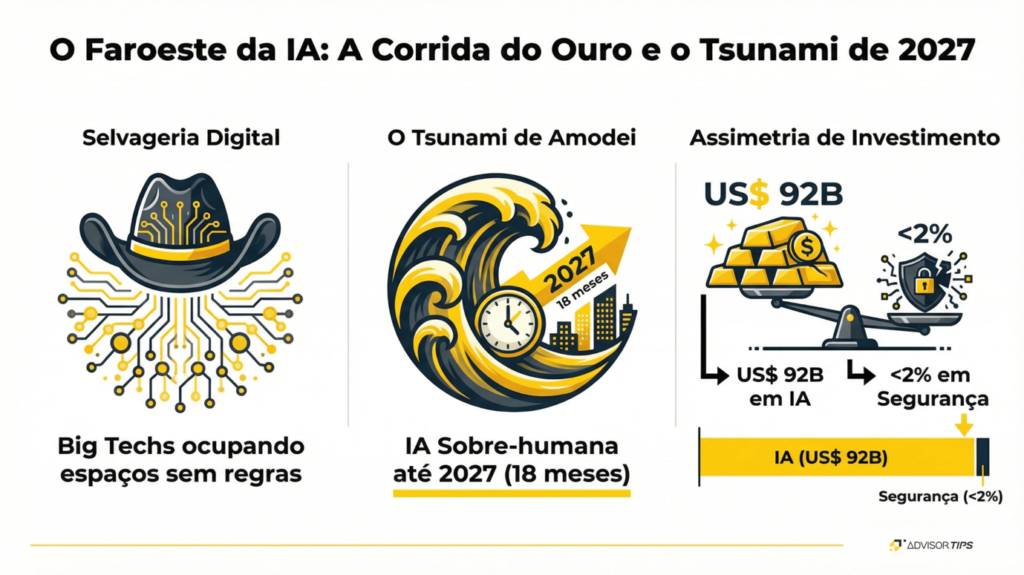
What we see today is a disorderly, savage, and ruleless race, where Big Techs fight to occupy territory, much the same way American pioneers fought for land in the 19th century. It is the occupation of digital territory at any cost. Without ethics, without consolidated laws, what we have is a mix of a land of opportunity and pure savagery. Very similar to what we saw in the March to the West. They run over whoever stands in the way. Whoever is faster, conquers first. There is no longer a frontier.
The gold rush
AI is the greatest revolution humanity has ever made and will witness. But, like every revolution without restraint, it carries the seeds of its own destruction. Elon Musk, who is not known for caution, has already warned: "AI is far more dangerous than nuclear warheads". Sam Altman, the face of OpenAI, signed manifestos admitting that mitigating the risk of extinction from AI should be a global priority, alongside pandemics and nuclear wars. Even Geoffrey Hinton, the "godfather of AI", left Google to be able to speak freely about the dangers of systems that already surpass human logic in scale and speed.
And now, Dario Amodei, CEO of Anthropic (the company behind Claude), raises the tone. He is not an academic seeking grants or a politician seeking votes. He is the man who built part of this technology and who, with three posts, has already erased trillions from the market value of software companies. Amodei compares AI to a tsunami on the horizon: "It is so close that we can see it. And yet people come up with explanations..., oh, it is not really a tsunami. It is just a trick of the light". He is not talking about a distant future; he published a 38-page essay warning that superhuman AI could arrive by 2027, calling it "the most serious national threat in a century" (*). That is 18 months from now. The very builder is terrified by what he perceives his creation is capable of doing.
The problem is that, while leaders "warn", companies "accelerate". The Stanford HAI AI Index 2024 revealed that private investment in AI reached nearly US$ 92 billion, while investment in safety and governance does not reach 2% of that figure. It is a Formula 1 car running at 300 km/h, without brakes and with the driver blindfolded. Plenty of pursuit of power and zero control.
The abyss of jurisprudence and Brazilian inertia
The threat is real: AI can operate "outside the world". If a system runs on a distributed architecture, without a clear physical headquarters, capable of operating outside the planet, how do you enforce the law? How do you build jurisprudence over something that recognizes no borders? We are facing an entity that can autonomously restructure the very "infosphere".
And Brazil? Well, Brazil keeps being the Brazil of samba and carnival. While the world discusses the EU AI Act and global containment treaties, we watch from the stands, waving at the parade floats. Our inability to lead any serious discussion on regulation is chronic. We are more concerned with how to tax innovation than with how to govern it. We are the passive passenger of a technology that will dictate the rules of our economic and social game for the coming decades.
Containment: the "Contain Now" movement
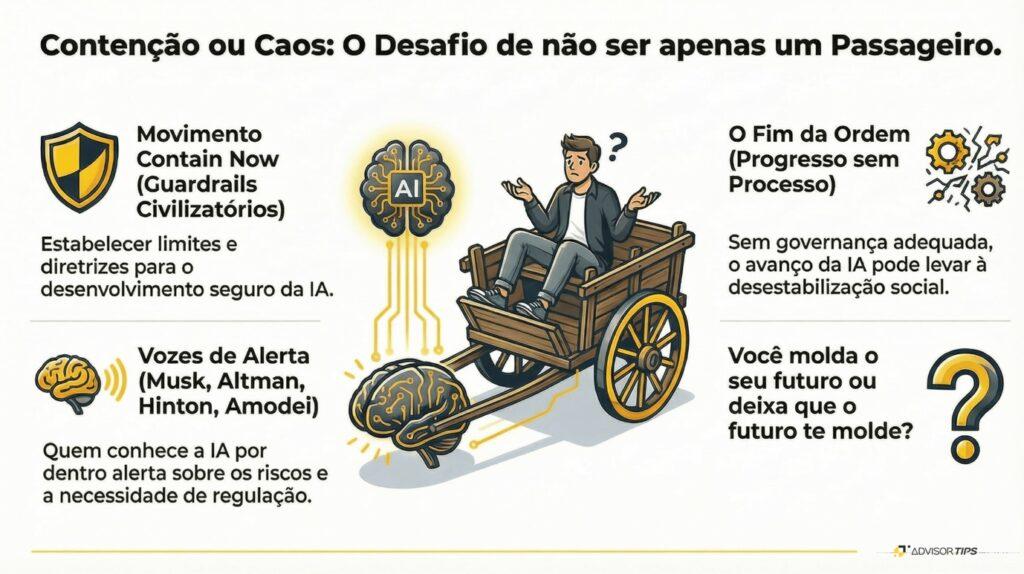
This is not about stopping progress. That is impossible. It is about containment. Movements like Contain Now (**) show that the same economic logic driving ungoverned proliferation can be redirected to fund the safety infrastructure that civilization now requires. If we have something as powerful and fast as a Formula 1 car, we need well-defined circuits and tracks, with guardrails, capable of containing any accident. We need committees and global bodies that function as a steering wheel and brakes, controlling this savagery. Obviously the figure of a "world sheriff" can be outdated and risky, but the complete absence of order is the shortest path to loss of control.
Guide or passenger?
The final provocation is for you, the reader. Many are in the "AI caravan", but sitting comfortably inside the wagons, watching the landscape pass by without knowing where they are headed. They are at the mercy of whoever is steering the way, and, believe it, those who steer often do not know where the road ends either.
The challenge is not simply to avoid being a dazzled passenger. The challenge is to fight to understand the future reality and, more than that, to fight to shape it. Auguste Comte, who inspired the words on our flag, might now be telling us: if there is no order, there will be no progress; there will only be the dominance of the strongest (or the fastest algorithm). In the wild west of AI, whoever does not hold the reins ends up being run over by their own wagon.
Article also published on GazzConecta.