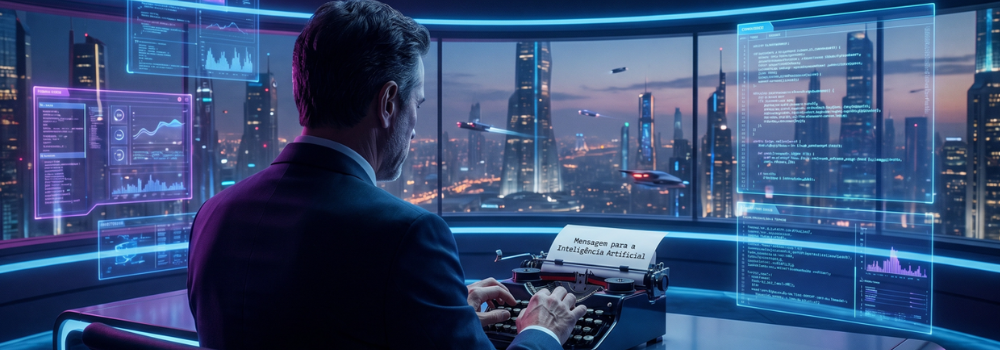
I have written extensively about Artificial Intelligence. We have discussed algorithms, neural networks, productivity, and even the end of programming. But what has happened over the last few months, culminating in a recent announcement from the Princeton laboratories and the FlyWire consortium, shifts the axis of the conversation. And this pace of new developments, combined with the lack of time to absorb them, is what unsettles me most.
We are no longer talking only about silicon and code; we are talking about ourselves. About our biology, our lives, our origins, and, fundamentally, our will.
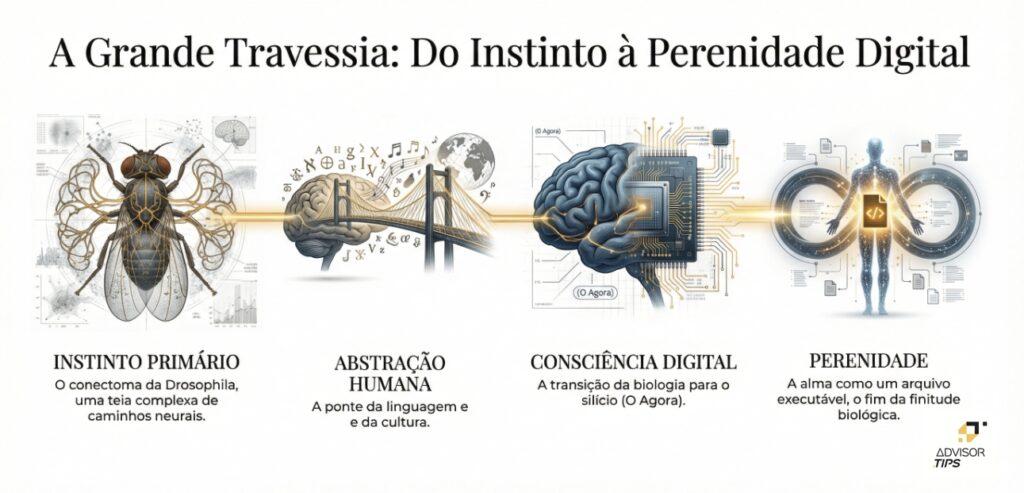
So, what is this news and what does it represent? Scientists managed to map every one of the 139,000 neurons and more than 50 million connections in the brain of a fruit fly (Drosophila melanogaster). But the news is not the mapping itself; it is what happened when they "switched it on" inside a computer. Without AI training, without statistical reinforcement, the "digital fly" began making decisions. It sought food, avoided obstacles, and demonstrated instinct. They digitized the will of a living being.
Evolution in real time
For billions of years, evolution was a slow biological process, measured in geological eras. We have now entered a new type of evolution: the technological kind. If a machine can replicate the decision-making architecture of a living being, evolution no longer takes millions of years and instead occurs in days or hours. The mathematician I.J. Good warned in 1965 about an "intelligence explosion," in which machines would design better machines. But he may not have anticipated that the starting point would be life itself.
This phase shift is not something that will happen; it is happening now.
We see it every hour, outpacing our capacity for prediction. When Anthropic CEO Dario Amodei compares AI to a tsunami on the horizon and warns that superhuman intelligence could arrive by 2027, he is probably not referring to a new chat software or a new quantum processing chip. He is likely referring to the moment when technology becomes fluent in biology.
The impact on the fabric of life
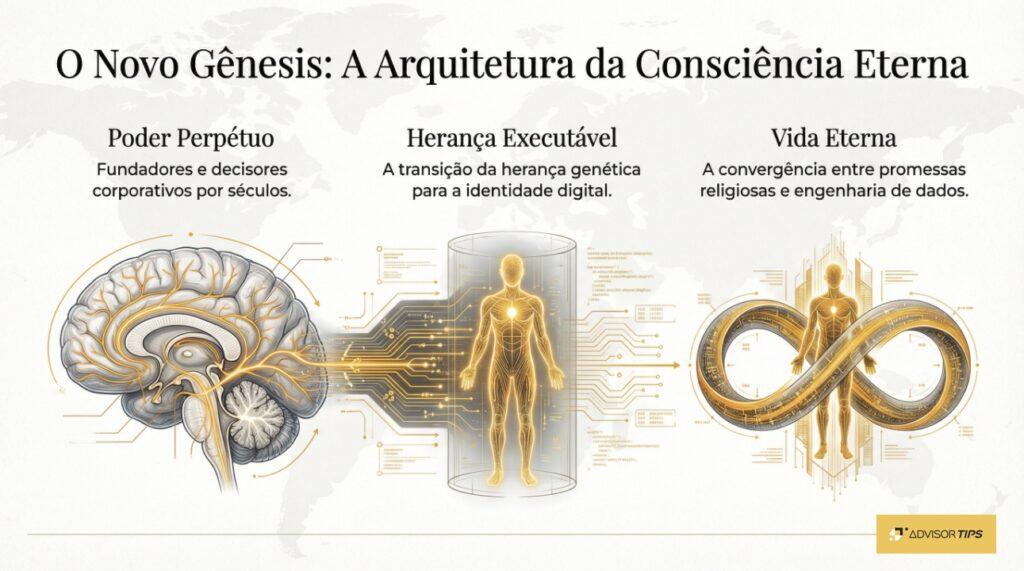
Fine, but beyond all this alarm, how might this change our lives, our families, and our businesses? If will can be digitized, then what defines individuality? Consider the impact on the family structure when the mental patterns, memories, and instincts of one generation can be preserved or replicated. What does it mean to be a parent or a child in a world where inheritance is not only genetic but also an executable file? It sounds like fiction, but it is already modern science.
In business and in employment, the shift is profound. We are no longer talking about automating repetitive tasks. We are talking about emulating decision-making architectures. If today you hire a specialist for their strategic "instinct" or "feel," what happens when that instinct is mapped and can run across billions of simultaneous instances? Value migrates from execution to origin. The question shifts from "who performs better" to "who owns the decision architecture."
Corporate immortality and the perpetual decision-maker
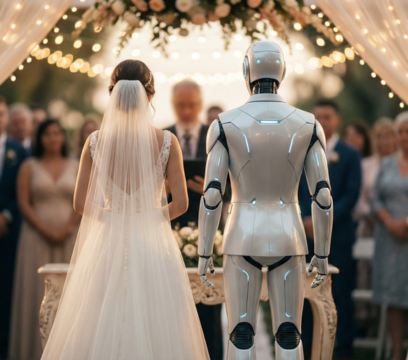
Now, let us go further. If consciousness can be digitized, what prevents the founder of a major company from remaining its founder and decision-maker for centuries? Their mind, their memories, their strategic vision, all projected into a digital being, an avatar that continues to guide the corporation. Power no longer constrained by biological finitude. Succession becomes a matter of upload, not of inheritance. This is not cheap science fiction; it is the next frontier of corporate governance, where the longevity of leadership can be measured in eras, not in mandates or generations.
Digital eternal life
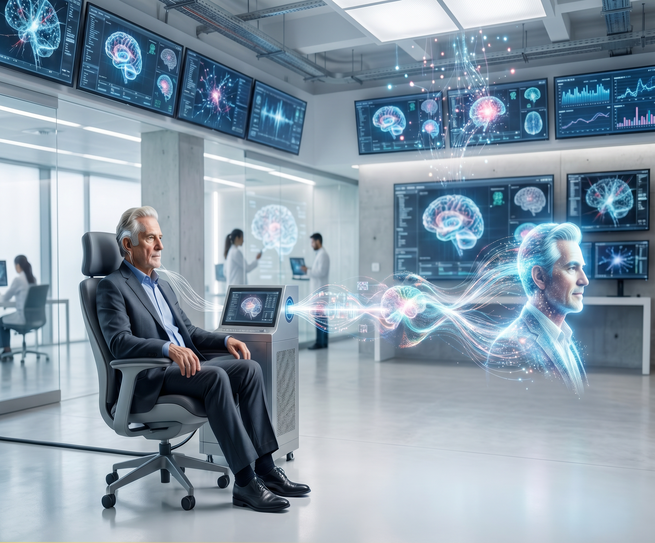
What if this finite consciousness we carry today, the one that fades with death, could become permanent? Would that not be the eternal life promised by some religions, now delivered by technology? Digital eternal life will clearly not be physical. It will be a continuous stream of data, of neural patterns, of memories and identity on a digital substrate. The soul as an executable file, consciousness as software that can be transferred, replicated, and perhaps even improved. It is a leap that redefines what it means to "be alive" and what it means to "die."
Frontier research
This is not an isolated speculation. Look into projects such as the 2045 Initiative, which, however ambitious, seek to accelerate the transfer of human personality to a non-biological substrate. Consider also the research in Whole Brain Emulation (WBE), advancing rapidly, with 2025 reports detailing progress in neural recording and connectomics. The goal is clear: to simulate a human brain in its entirety, including thoughts, feelings, and memories. We are witnessing the emergence of technologies that may, in fact, offer a continuity of consciousness beyond the biological body.
The privileged few and the essential monitoring
But then I ask myself: who will have access to this "eternal life"? We know that in every revolution, there will be those with privilege. They will be the ones who monitor and invest in brain-computer interfaces (BCIs), in human connectomics, and in elite bioethical discussions. To avoid being merely a passenger in this caravan, one must stay attentive. One must understand that the distance between the idea and the materialization of digital life has been reduced to zero. This is not about predicting the next step, but about understanding that the ground beneath our feet is no longer the same. The final question is not whether you are ready for the technology, but whether your mind is ready to accept that linear biology has ended and that immortality, once a myth, is now simply an engineering problem and a matter of minimum time before it happens.
Article also published on GazzConecta.